
The TAC (Total Alkalinity Title) determines the stability of pH. When the alkalinity of your pool exceeds the target range, the pH becomes difficult to correct and treatments lose effectiveness. Reducing the TAC without draining the pool relies on two complementary levers: fractional acidification and mechanical surface aeration.
Acid Injection and Aeration: The Combined Protocol to Lower TAC
Acid alone simultaneously lowers both pH and TAC. The problem is that the pH quickly drops too low before the alkalinity is brought back to a correct level. Mechanical aeration resolves this deadlock: it degasifies dissolved CO₂, which raises the pH without affecting the TAC.
The protocol works in a loop. An acid dose is injected to lower both pH and TAC together, then aeration (jets, waterfall, counter-current swimming, aerator) is applied to raise the pH alone. This process is repeated until the desired TAC is reached.
Feedback from maintenance teams (campgrounds, residences, hotels) confirms that by fractionating the acid doses and maintaining continuous filtration during the aeration phases, the TAC significantly drops within a few days, without draining. We recommend not to let the pH drop below 7.0 in each cycle to protect the equipment and the liner.
To explore quick solutions for high pool alkalinity, this acid-aeration protocol remains the most reliable method in the field.
Hydrochloric Acid or Sodium Bisulfate: Which Product to Reduce Pool Alkalinity
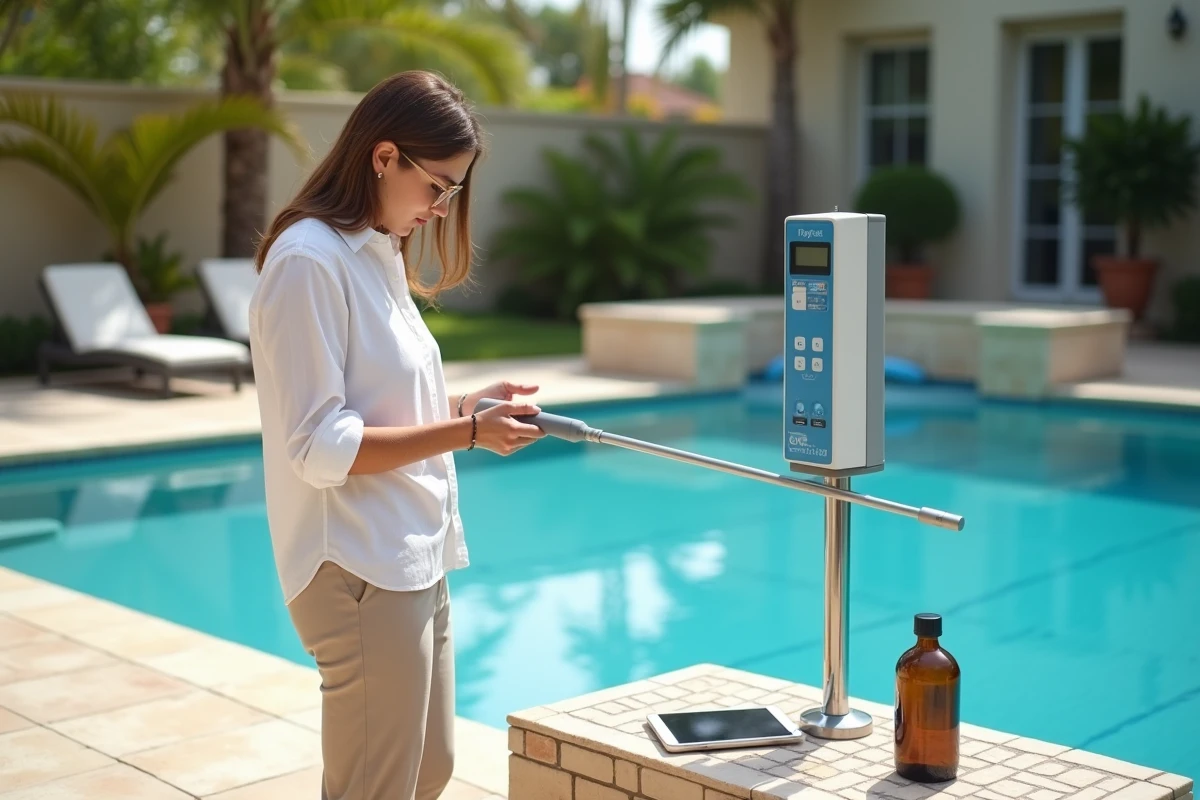
The choice of acid product affects the speed of correction and the side effects on the pool water.
Hydrochloric acid (liquid pH minus) acts quickly, but its handling requires strict precautions: corrosive vapors, dosing in milliliters, risk of burning the liner if poured without dilution. We mainly use it on concrete or tiled pools, where the chemical resistance of the coating allows it.
Sodium bisulfate (powder or granules pH minus) is easier to dose for individuals. Its reaction is more gradual, which reduces the risk of acute overdosing. However, it introduces sulfates into the water, a parameter to monitor in the long term if you correct the TAC multiple times per season.
- Hydrochloric acid: fast action, delicate handling, suitable for concrete or tiled pools with good ventilation in the technical room
- Sodium bisulfate: more tolerant dosing, gradual dissolution, preferable on liners and polyester shells
- Diluted sulfuric acid: used by automatic regulation systems (Hayward, Pentair, Zodiac/Fluidra) for controlled injection that targets TAC while limiting pH drop
Recent instructions from Hayward (pH Perfect) and Zodiac (pH Expert) explicitly recommend the controlled injection of diluted sulfuric acid to primarily lower TAC, marking a shift from older generic recommendations on “pH minus”.
Fractionating Doses: Why Single Acid Dosing Does Not Work
Pouring a massive dose of acid to correct TAC all at once is the classic trap. The pH plunges below the safety threshold, metals in the circuit (copper from heat exchangers, stainless steel screws) begin to corrode, and the coating undergoes localized chemical stress.
Fractionation requires working in stages. Each acid addition should not drop the pH below 7.0. We wait for aeration to bring the pH back between 7.2 and 7.4, then we restart a cycle.
In a residential pool, we generally observe that several cycles spread over a few days are needed to bring high TAC back into the target range. Filtration must run continuously throughout the protocol to homogenize the water and promote CO₂ degassing.
Common Sources of High Alkalinity in the Pool
Correcting TAC without identifying the cause is like emptying a leaky bucket. Several factors cause alkalinity to rise recurrently.
- Naturally hard and alkaline filling water: in some French regions, tap water arrives with a TAC already above the ideal range for a pool
- Excessive use of calcium hypochlorite (unstabilized shock chlorine): this product increases both pH and TAC with each treatment
- Regular addition of baking soda to raise low pH, without prior measurement of TAC: TAC mechanically rises
- Strong evaporation in summer: water evaporates, mineral salts remain, carbonate concentration increases
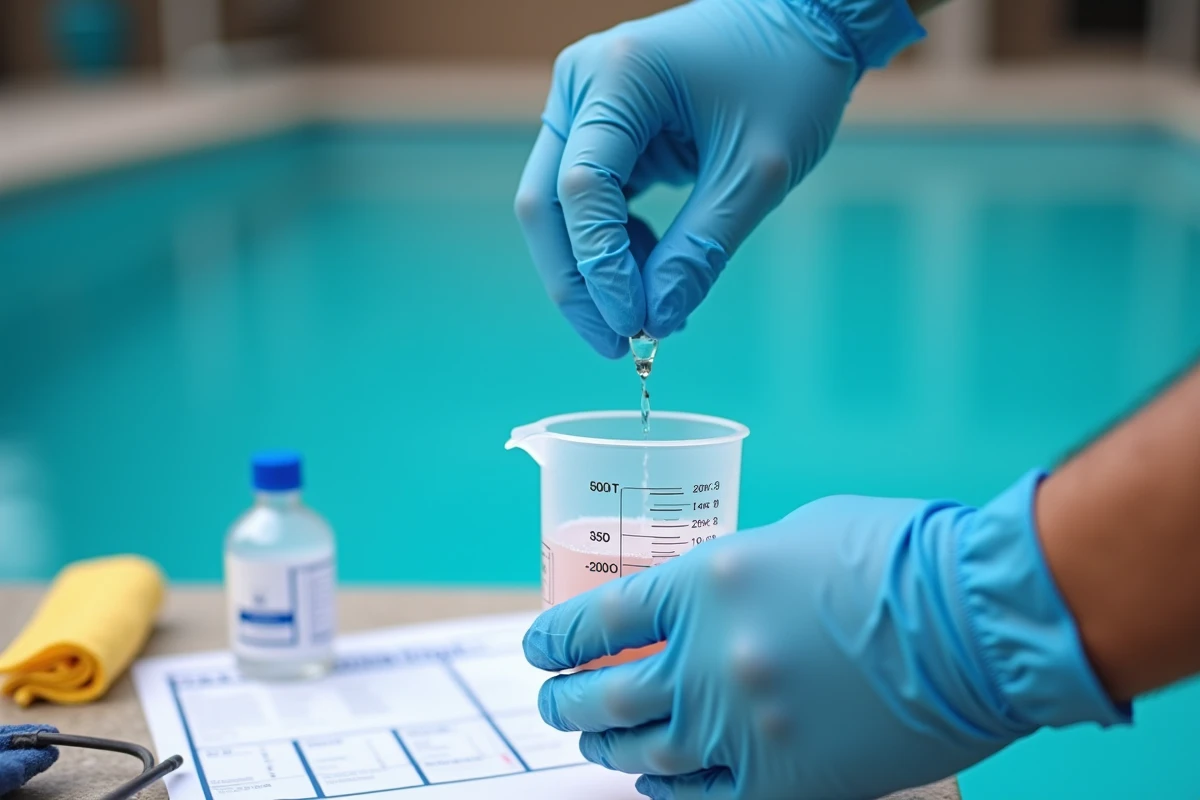
Before any correction, we recommend testing the filling water alone (a simple test strip kit is sufficient) to determine if the problem is structural. If the TAC of the tap water is already high, every refill of the pool will reproduce the imbalance.
Automatic TAC Regulation: What Recent Systems Change
Automatic pH regulators now integrate a logic for correcting TAC. The systems from Hayward, Pentair, and Zodiac/Fluidra calibrate the doses of acid injected to target alkalinity without letting pH fall below the set threshold.
This automated approach replicates the acid-aeration protocol but with a dosing precision that manual addition cannot match. For a collective pool or an individual facing chronically high TAC, the investment in a regulator pays off in product savings and water stability.
The limitation remains aeration: a regulator injects the acid, but it does not create surface movement. If your setup lacks jets, a waterfall, or counter-current swimming, the pH will drop without CO₂ being released, and the correction cycle will be incomplete. Coupling the regulator with a mechanical aeration device allows you to make the most of automatic injection.
A controlled TAC stabilizes pH, reduces the consumption of corrective products, and prolongs the lifespan of equipment. By identifying the source of the imbalance and applying the fractional acid-aeration protocol, correction can be achieved in a few days without wasting a cubic meter of water.