For a long time, it was believed that only lightweight metal could reduce the energy costs of cars. Now, the equation has become more complex: automated platforms relieve technicians of certain tasks, while connected tools are being installed everywhere. Workshop expertise is evolving, influenced by signals sent by sensors and algorithms, sweeping away old routines with a digital wave.
Electrification is progressing at a rapid pace. Industry giants and small workshops alike have no choice but to reinvent themselves. At every level, tools are becoming more adaptable, forcing everyone to keep up. Adjusting, maintaining the pace, evolving with innovations: the transformation leaves no one behind, neither historical manufacturers, independent structures, nor specialized suppliers.
Why innovation is transforming automotive equipment today
The workshop universe is shifting into the digital age. Manual intervention is giving way to a host of technological aids: omnipresent sensors, real-time diagnostics, AI that analyzes anomalies. Each technical operation, once meticulously recorded in notebooks, now benefits from complete traceability and increased efficiency. Nothing is left to chance or approximation.
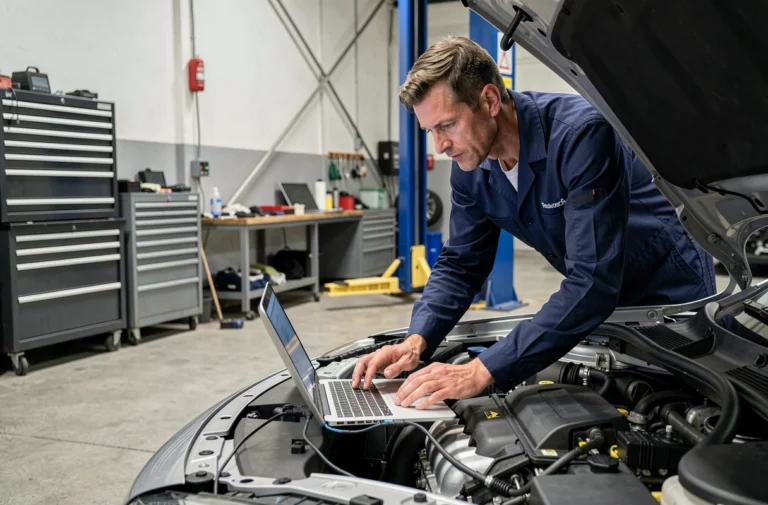
Predictive maintenance is taking charge: the vehicles themselves transmit their health status, signal upcoming threats, and guide technicians toward the appropriate action. Information exchanges flow uninterrupted, connecting tools, platforms, and users to prevent even the slightest unexpected downtime. Administrative routines are fading away: goodbye to heavy binders, tablets have taken over. Each screen displays intervention histories, step-by-step guides, and updated methods. Searching for a procedure, checking each step, or exploring new diagnostics can be done at your fingertips.
For those who wish to stay up to date, spot trends, or delve deeper into the evolution of equipment, a reference resource is essential: the site mtm-france.com for the automotive sector.
What technologies are disrupting the tools of industry professionals?
The shift from thermal to electric is reshuffling all the cards. Each of these technologies imposes its own constraints and pushes for a rethinking of the technical arsenal. No more room for improvisation: precision is essential, supported by reliable, configurable, and interconnected equipment. Interventions are compartmentalized, made seamless by automation and centralized management. “Paper” methods are fading in favor of software platforms that orchestrate every mission: planning, tracking, tasks coordinated down to the smallest detail. Thanks to predictive maintenance, anticipating breakdowns becomes possible, and care is continuously refined.
What tools are now at the heart of practice? This list provides an overview of the daily essentials:
- Scan tools: they scan electronic systems in real-time and deliver reliable diagnostics on the fly
- Secure gateways: they protect the workshop from cyberattacks, filter access, and preserve data integrity
- Automated washing stations: their presence ensures impeccable hygiene of equipment, without tedious human intervention
Keeping pace requires continuous training, testing new tools, and adjusting practices with each technological advancement. This is the price to pay to remain competitive on the ground and in the workshop.
Leading companies: an overview of solutions and players shaping the future
Behind the scenes, teams of experts are envisioning each new step in the industry. From the design phase, three requirements guide their actions: technical reliability, operational performance, and speed of adaptation. Computer-aided design is everywhere: it integrates environmental impact and connectivity from the initial plans, creating tools capable of evolving with market demands.
Within French workshops, obtaining an ISO certification remains a benchmark. It ensures the versatility of tool ranges, the ability to meet the growing diversity of models, and becomes a mark of seriousness for every partner in the sector.
Examples of solutions and dynamics
To visualize this transformation, three trends stand out clearly:
- Flexible manufacturing systems: they allow for immediate switching from one model to another, increasing responsiveness without degrading performance.
- Computer-aided design (CAD): here, every feedback from the field reaches technical teams and accelerates the transition from prototype to mass production.
- Smart tools: constant monitoring, automated maintenance, remote configuration… These tools save valuable time and secure every step of the work.
Being ready to change course as soon as technology demands it: that’s where the difference lies. Those who maintain the pace know how to sense novelty, adapt to any evolution, and seize their chance at the next breakthrough. Who will pierce the fog of innovation and take the lead tomorrow?