
A 150 horsepower diesel engine that leaves the factory with a map limited to Euro 6d standards: this is where engine reprogramming begins. The manufacturer calibrates the ECU to meet regulatory, thermal, and warranty constraints, not to exploit the full mechanical potential of the engine.
Modifying this map involves adjusting the injection, turbo pressure, and ignition timing to unleash a power and torque that the mechanics can already handle.
Removal of anti-pollution systems: the legal risk that power reprogramming does not cover
Two very different operations are often confused. On one side, there is software optimization that tweaks the injection and turbo maps. On the other, there is the neutralization of the particulate filter (DPF), the EGR valve, the catalyst, or the SCR/AdBlue system.
The latter falls under Article L318-3 of the Highway Code. The fine can reach 7,500 euros, accompanied by vehicle immobilization and refusal at the technical inspection. Disabling an anti-pollution system is a separate offense from power reprogramming, and many online tuners do not clearly differentiate in their offers.
When looking for a serious professional, the first question to ask is precisely on this point: does the service retain the entirety of the original anti-pollution chain? The specialists listed on vegatuning.fr allow you to compare the services offered and check this criterion before committing.
Engine reprogramming and technical inspection: what the inspection really checks
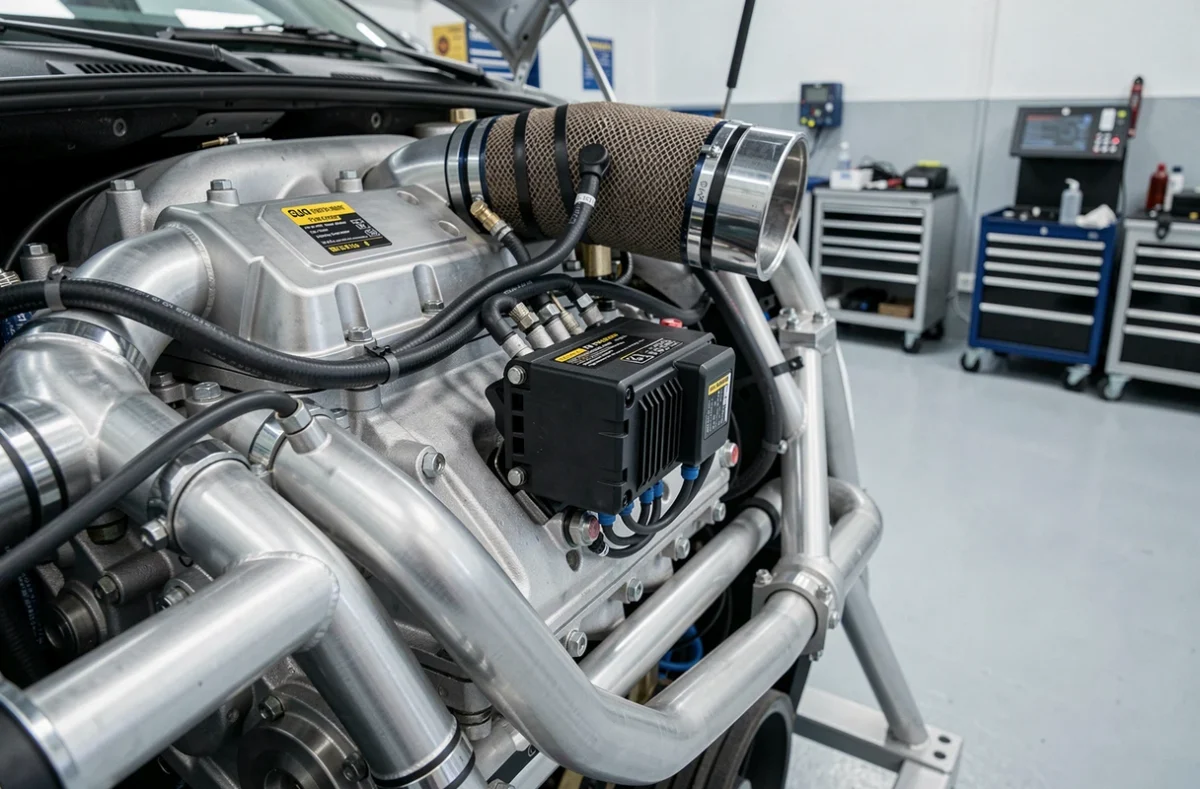
The technical inspection focuses on emissions measured at the exhaust, faults reported by the OBD port, and the apparent condition of the vehicle. It does not read the map stored in the ECU. Passing the technical inspection does not prove that the reprogramming is homologated or declared to the insurer.
This is a nuance that many owners discover too late. A reprogrammed vehicle can very well pass the technical inspection, especially if the emission thresholds remain within tolerances. However, in the event of a claim, the insurer may appoint an expert who will detect the software modification through the ECU reading.
In practice, the risk does not materialize at the inspection center, but during an accident or a dispute with the insurance company. Declaring the modification to your insurer remains the only reliable precaution.
E85 conversion by mapping or approved box: two very different statuses
The conversion to superethanol E85 is attracting more and more drivers for economic reasons. Two paths exist: the approved conversion box and the reprogramming of the engine map.
- The approved box, regulated by the decree of November 30, 2017, must be installed by an authorized installer. It allows for modifying the registration document to include the mention FE (flexfuel ethanol).
- The E85 reprogramming, on the other hand, directly modifies the injection management in the ECU. It does not benefit from the homologation procedure and does not allow, by itself, for the legal registration of E85 on the registration certificate.
- In the event of a roadside check or an accident, the absence of official homologation exposes the owner to a refusal of coverage by the insurer, regardless of the vehicle’s technical functioning.
Feedback varies on this point: some drivers have been using an E85 map for several years without difficulty, while others have faced a refusal of compensation after an accident. The administrative status settles the question, not the feeling behind the wheel.
Stage 1 and stage 2: choosing the level of optimization suited to your use

The terms “stage 1” and “stage 2” appear in all engine reprogramming offers, but their actual content varies according to the tuners.
A stage 1 refers to a modification that is exclusively software-based. The original map is adjusted (boost pressure, amount of fuel injected, ignition timing) without changing any mechanical parts. The stage 1 remains within the mechanical tolerances of the original engine, making it the most common option for daily use.
The stage 2 involves replacing certain components: downpipe, intake, larger intercooler. The map is then adapted to these new parts. The gain in power and torque is more pronounced, but the investment and maintenance constraints increase proportionally.
- For a daily commute vehicle, stage 1 offers a noticeable torque gain from low revs, with a contained budget.
- For track use or a pursuit of performance, stage 2 makes sense, provided that more rigorous mechanical follow-up is planned (frequent oil changes, checking pressure hoses, monitoring exhaust temperatures).
- Beyond stage 2, we enter the realm of competition preparation, with internal modifications (forged pistons, reinforced connecting rods) that fall outside the scope of a road vehicle.
Manufacturer warranty and insurance after engine reprogramming
Any modification of the original map constitutes a legitimate reason for refusal of the manufacturer’s warranty on the powertrain. Most manufacturers have diagnostic tools capable of detecting that an ECU has been flashed, even if the original map has been restored afterward.
Engine reprogramming cancels the manufacturer’s warranty on the powertrain in almost all cases. Waiting for the end of the warranty period remains the most prudent choice for a recent vehicle.
On the insurance side, the situation is more nuanced. No law prohibits driving with a reprogrammed vehicle, but the insurance contract generally requires the declaration of any technical modification. Failing to declare the reprogramming exposes you to a loss of coverage in the event of a claim, even if the claim has no connection to the modification.
A competent tuner provides a reprogramming certificate detailing the modified parameters. This document facilitates declaration to the insurer and serves as useful proof in case of vehicle resale.