Creating a natural and flowering garden requires understanding what the soil and exposure allow before choosing any plants. Two neighboring plots, with different soil pH or opposite orientations, will not support the same plants. The goal is not to accumulate species, but to select those that thrive without permanent artificial compensation.
Soil, exposure, and water: the three variables that determine a flowering garden
Before purchasing plants or seeds, three parameters condition the success of a natural garden. The table below summarizes their effects on plant selection and the maintenance required.
| Variable | What it determines | Consequence if ignored |
|---|---|---|
| Soil type (clay, sandy, limestone) | Water retention capacity, pH, available nutrients | Inappropriate plants, high mortality in the first year |
| Exposure (full south, partial shade, shade) | Hours of sunlight, soil temperature, evaporation | Poor flowering, excessive vegetative growth or scorching |
| Water resource (local rainfall, possibility of collection) | Frequency of watering, choice of drought-resistant species | Overconsumption of drinking water, repeated water stress |
Clay soil retains water but compacts. Sandy soil drains quickly but does not nourish. Analyzing the soil before planting avoids most failures. pH analysis kits can be found at garden centers for a few euros.
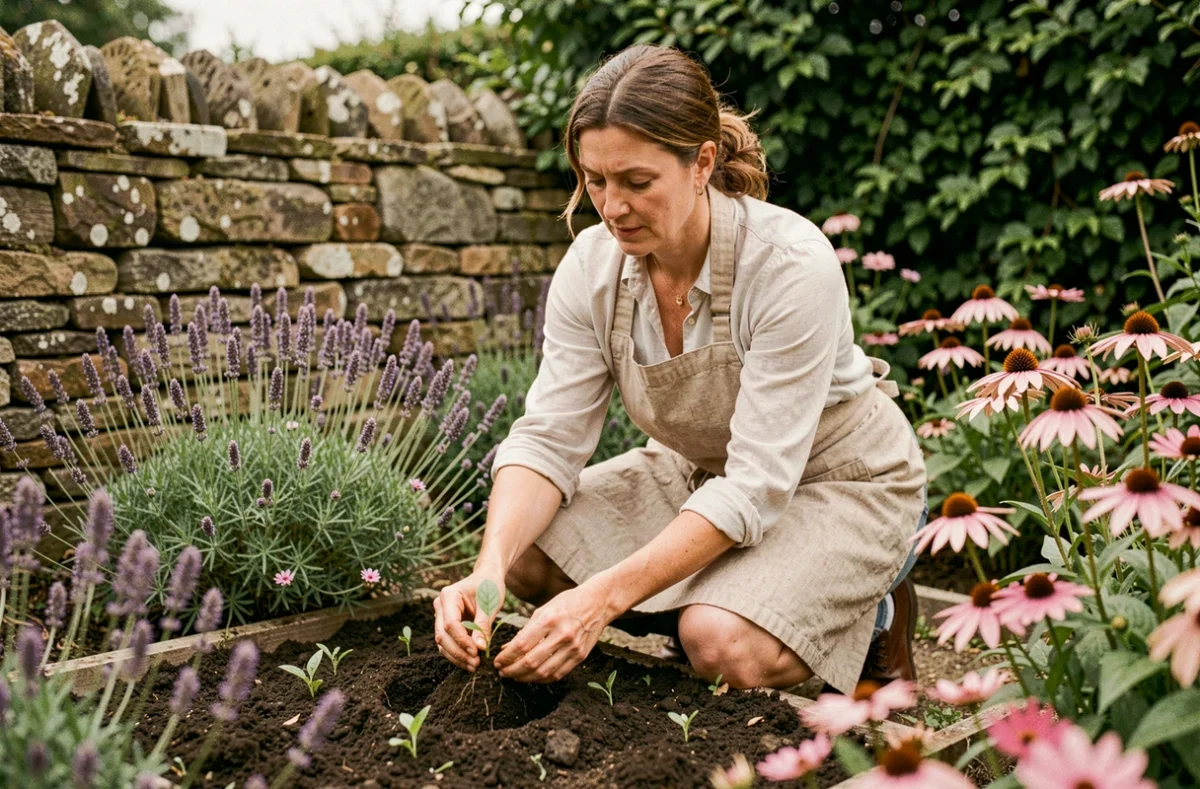
Exposure plays a direct role in the plant palette. A bed oriented full south in an oceanic climate is not managed the same way as the same bed in a continental climate. Mediterranean plants (lavender, thyme, sage) tolerate heat and well-drained soil but suffer in heavy, wet earth.
Resources like dededanssonjardin.com help identify plants suited to each terrain and climate configuration, reducing guesswork at planting time.
Water management in the garden: prioritize rooting over watering
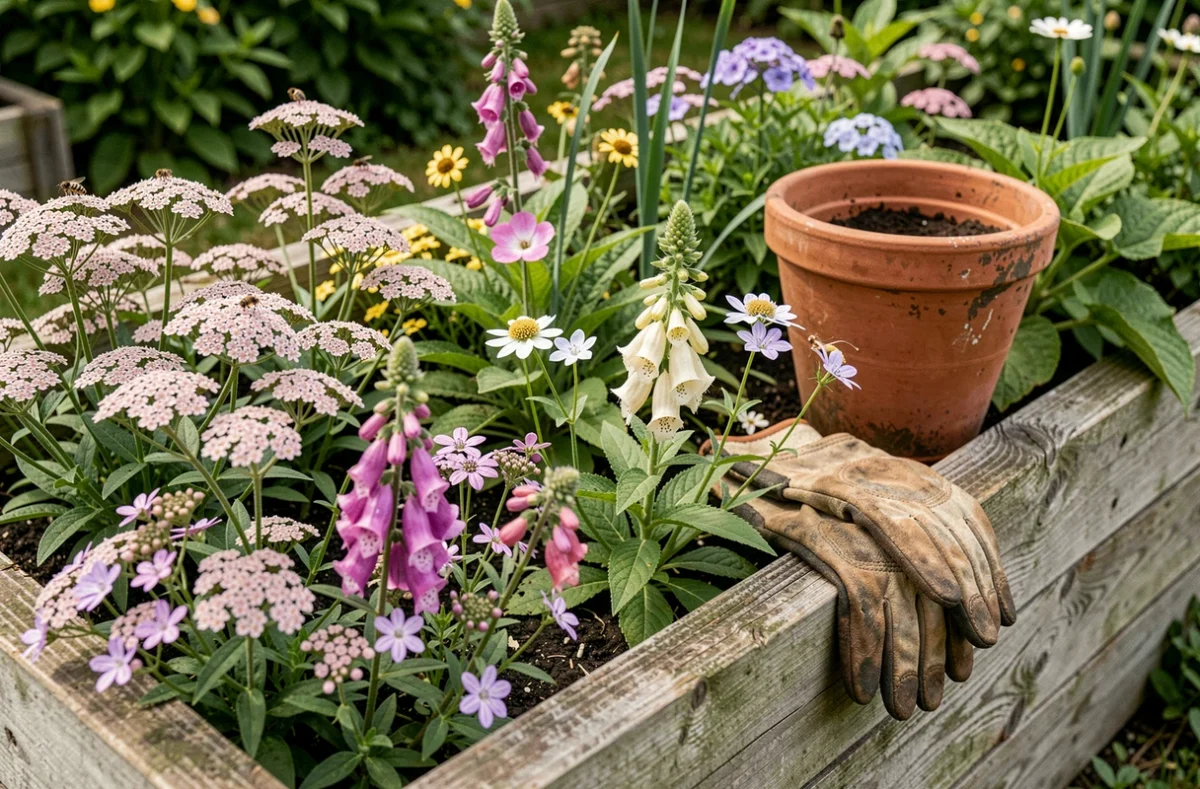
Water management has become a central criterion in designing a flowering outdoor space. Recent feedback, reported by France Inter on August 27, 2026, shows that after thorough watering in the first year, some drought-resistant plantings can then go without watering, provided that deep rooting was encouraged rather than aerial growth.
This approach reverses the usual logic. Instead of watering little and often (which keeps roots near the surface), we water abundantly but spaced out during the first months. The roots go down to seek moisture deep in the soil. In the second year, the plant is self-sufficient.
Mulching and green waste: a legal obligation turned asset
Since January 1, 2024, the AGEC law requires municipalities to offer a source separation solution for green waste. Dead leaves, grass clippings, prunings, and chippings are no longer waste to be disposed of: they are resources for the garden.
- Organic mulching (branch chippings, dead leaves, straw) covers the soil, limits evaporation, and nourishes the soil microfauna as it decomposes
- Homemade compost, made from kitchen and garden waste, improves soil structure and fertility without chemical input
- Grass clippings, spread in a thin layer, form an effective temporary mulch between the rows of a vegetable garden or at the base of flower beds
Incorporating green waste into the garden’s functioning reduces both waste volume and fertilizer costs. The soil regenerates, water retention improves, and earthworms return to colonize the plot.
Combining plants for a self-protecting natural garden
A flowering garden that operates without heavy interventions relies on plant associations planned in advance. Aromatic plants (lavender, thyme, sage) provide protection for their neighbors by repelling certain pest insects. This is not a foolproof remedy, but it is a first filter that reduces pest pressure.
Varying the plants grown each year breaks the development cycle of pests. Ideally, when the size of the garden allows, it is best to wait three to five years before replanting the same species in the same spot. This rotation also applies to flowering beds, not just the vegetable garden.
High mowing and areas of free evolution
High mowing, around six to eight centimeters, strengthens the grass’s rooting and its resistance to drought. It also prevents the germination of unwanted seeds and slows down moss development.
Leaving an area of the garden in free evolution (no mowing, no pruning) attracts pollinators and beneficial insects. An overly tidy garden is a biologically impoverished garden. A few square meters of spontaneous meadow are enough to create a refuge for useful insects.
Asian hornet and non-selective traps: a false good idea in the garden
In response to the growing presence of the Asian hornet, many gardeners set up homemade bottle traps. These devices capture insects en masse, but indiscriminately: bees, butterflies, hoverflies end up trapped just like the hornets.
The recent national framework prioritizes reporting nests and their destruction by professionals. Bottle traps are explicitly excluded from the official system, as reported by Cultinfos on September 2, 2026. Reporting an Asian hornet nest rather than setting non-selective traps protects the garden’s biodiversity. The reporting procedures depend on each department: the local prefecture is the appropriate contact.
- Do not install a bottle trap without formal identification of the threat
- Contact the town hall or prefecture to report a suspicious nest
- Favor nectar-rich plants to support local pollinator populations
A natural and flowering garden is not built in a single season. The first year serves to observe, test associations, and allow the soil to enrich itself under the mulch. In the second year, well-rooted plants begin to show their full potential, and maintenance is reduced to a few seasonal tasks. The real time savings are measured from the third year, when the garden’s ecosystem functions with minimal intervention.